The most powerful prison is not built with walls, but with the fear of being watched.
In psychology there are many mental experiments that are designed to change a person’s behavior, ideas, beliefs, activities, etc. These experiments can be seen as unethical or dangerous, but there is one that is one of the most fascinating ones there is.
The panopticon effect
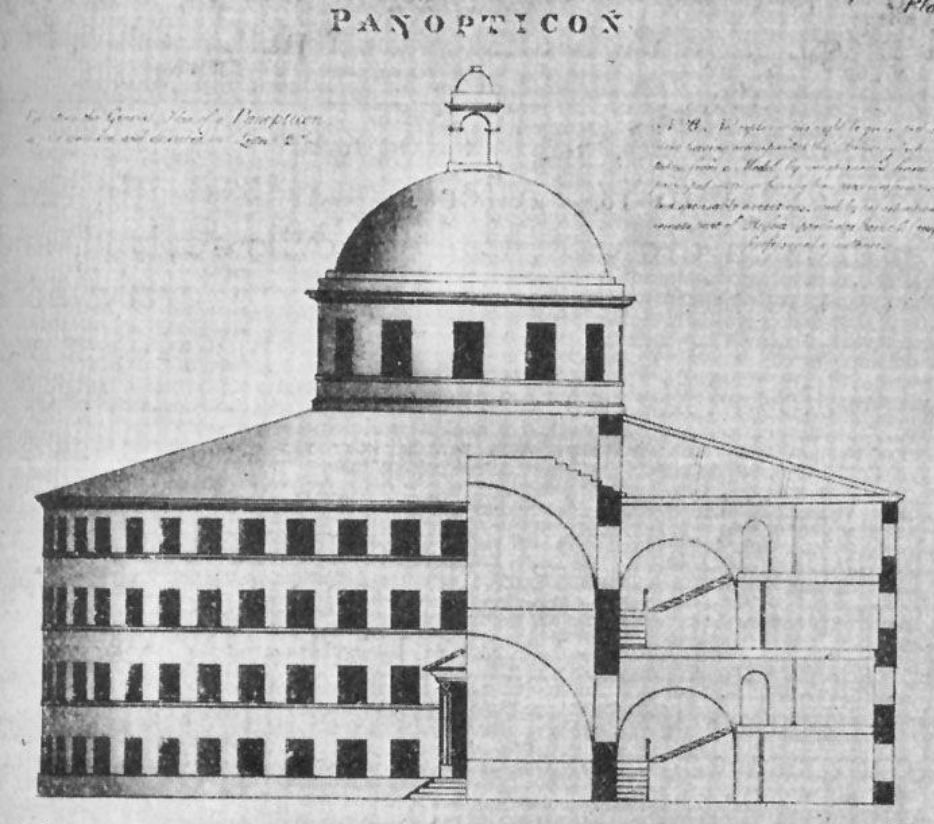
This effect is the psychological phenomenon where an individual changes their behavior solely based on the belief that they might be under surveillance, even if they are not actively watched. This effect was created and tried in a prison created by Jeremy Bentham. He was a famous English philosopher and social reformer, well known for being the creator of modern utilitarianism.
The prison was created in the 1780s, it was in the form of a circle, with a watch tower in the middle that oversees all the place. If there was a person inside it they would be able to see all of the prisoners but they were not able to see the watcher. Jeremy believed that when an individual feels seen they tend to change their behavior and act “behaved”, this was the main purpose, to make the prisoner paranoid by making them believe that all of their actions are monitored and can be punished, thus to make the act “correct”.
How does it work psychologically
This effect works by various psychological phenomena. One of the primary ones is that the belief that they are being observed, Humans do not need to see they are being watched, the belief is enough. Another key psychological phenomena is the internalized authorities, this is when a person overtime of being under the hand of authorities they tend to take the rules and internalize them to become their own. Another aspect is anxiety and hyper-awareness, this happens when the uncertainty of being watched creates a psychological tension, not knowing when you are being watched creates anxiety and your brain stays in a hyper-aware state, this makes you correct your state without thinking twice. Another one is The “Observer Effect”. This effect works because people tend to care about how others perceive them, Humans tend to search for social connections and have the desirability that they are biased towards them.
Real-life examples
- Security cameras in stores: people steal less
- Teachers walking around during exams: students cheat less
- Social media: people curate behavior because they feel observed
- Workplace monitoring systems
Summarizing all said before, The panopticon effect just not only works because of the visibility the observer has more so because of the psychological phenomenon that it creates; the paranoia of being observed, the fear of the repercussions their acts might have if they are being watched, and the hyper-awareness that a person unconsciously creates from being submitted to authorities.
In the end, no one needed to watch them — they had already learned to watch themselves


Leave a Reply